
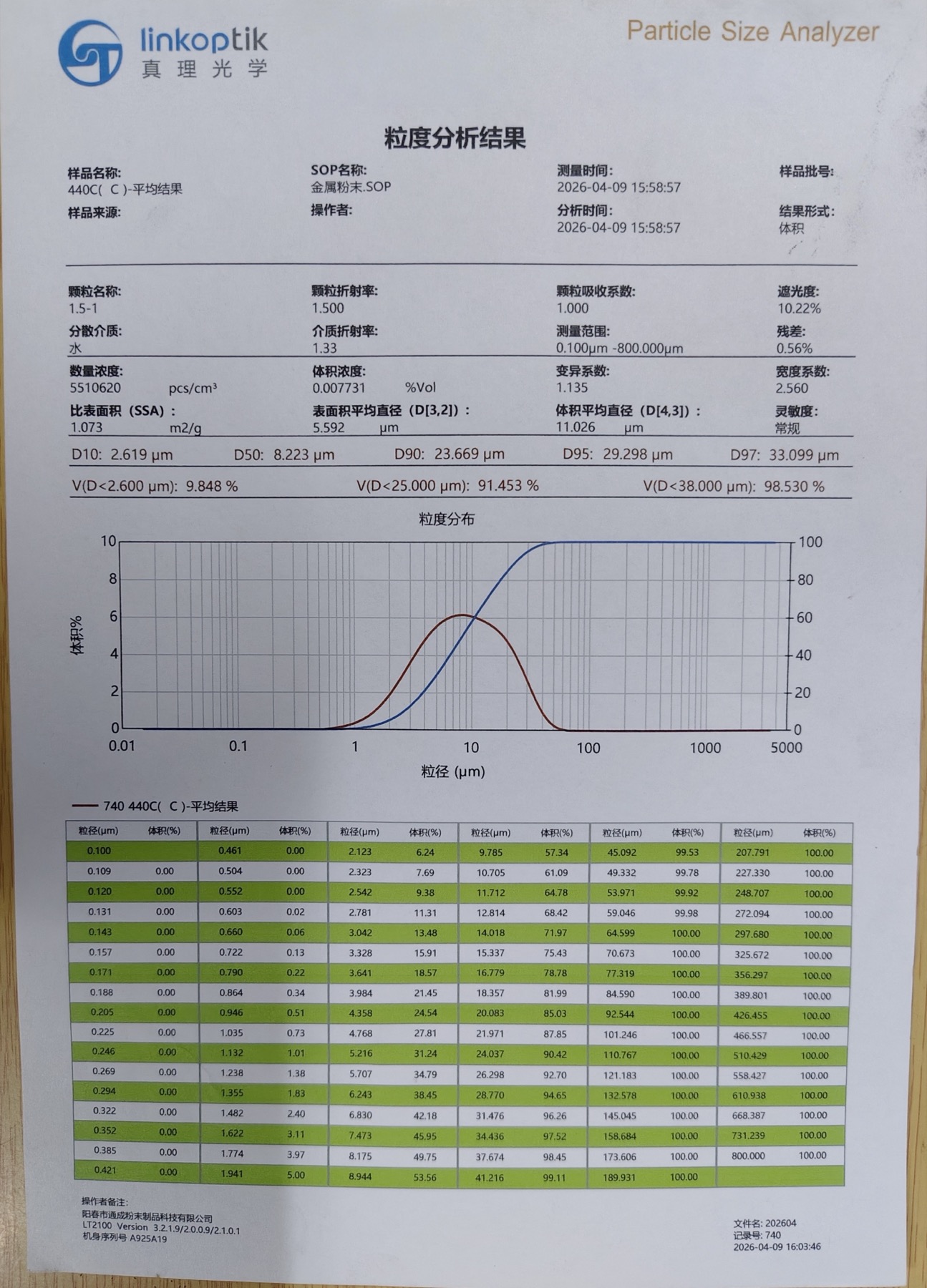
Use D10, D50, D90 and the full particle-size distribution curve to compare the fine fraction, median size, coarse tail and distribution width of stainless steel powders.
Engineering focus: Particle size analysis: D10, D50 and D90
Review the material, particle-size, process and validation factors that matter for this application.
Helps understand the effect of fines ratio on flow, feedstock and sintering.
Facilitates quick comparison, but is not a substitute for the full curve.
May affect thin wall fills, surface and local defects.
D10 / D50 / D90
Respectively represent the particle size positions when the cumulative volume distribution reaches 10%, 50% and 90%, which can be used to describe different intervals of the distribution.
Particle-size data for four Tongcheng materials
The available volume-based particle size test records show: 440C, D50 8.223 μm; 17-4PH, D50 8.706 μm; 17-4+3Cu, D50 9.150 μm; and 439, D50 9.896 μm. Each product page provides the corresponding test date, original report and full D10 and D90 values. The particle size specification for supply is confirmed for each project.
How particle size affects manufacturing
Particle size distribution affects powder flow, feedstock viscosity, mold cavity filling, press filling, debinding sintering, shrinkage and surface condition, so it should be selected together with the material grade and forming process.
Discuss your powder project
Share the process step, operating conditions and part result you want to improve.
- Target grade, batch or order information
- Particle size, density, flow or composition items of concern
- Customer inspection methods and receiving requirements
- Packaging, labelling, delivery and traceability needs
Technical references for this page
These references explain materials, processes or test methods. Third-party product data does not represent Tongcheng product specifications.