
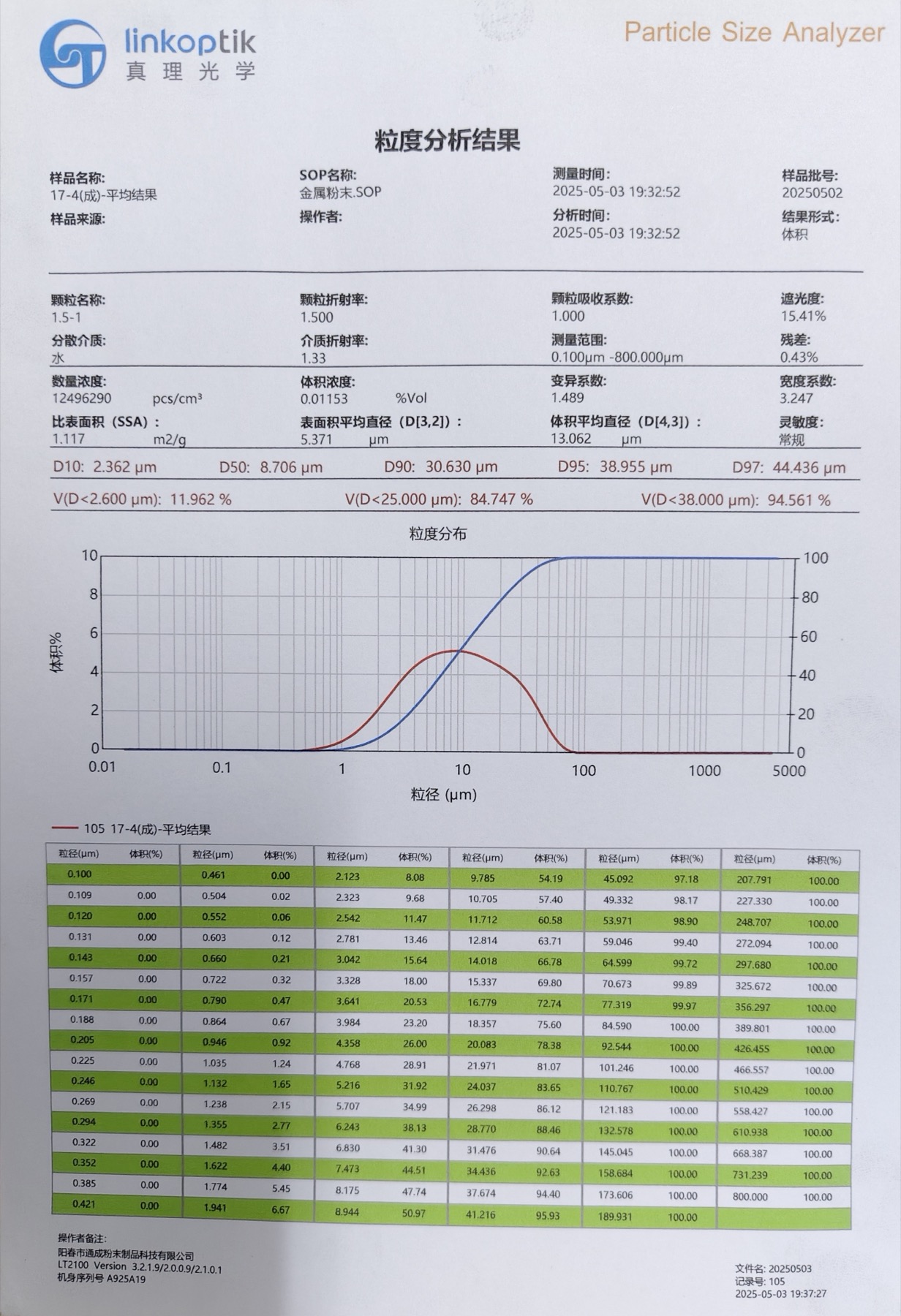
D10, D50, D90, and distribution width together describe powder particle size; they affect flow, filling, forming, sintering activity, and part surface.
Interpret the relationships between variables, not a single parameter
Explain how D10, D50, D90 and distribution width affect flow, filling, sintering and surface.
Do not rely on D50 alone
D50 is the median particle size; it does not show the fine fraction or coarse tail by itself. Review D10, D50, D90 and the complete curve to compare distribution position and width.
Particle size affects process performance
Finer particles generally provide greater specific surface area and sintering activity, but can increase agglomeration, oxidation, feedstock viscosity or flow difficulty. Coarser particles may improve some flow behavior while changing filling detail and the sintering window.
Compare results obtained with the same method
Particle-size results depend on dispersion, instrument settings and sampling. When comparing batches, supplier and customer should record the test method and sampling conditions rather than exchange only three numbers.
Discuss your powder project
Share the process step, operating conditions and part result you want to improve.
- Current material, powder or part issue
- Process step and observed symptom
- Available particle-size, composition, dimensional or performance data
- Equipment, process conditions and desired outcome
Technical references for this page
These references explain materials, processes or test methods. Third-party product data does not represent Tongcheng product specifications.